 October 2026
Assignment of Patent Rights Agreement: What It Transfers
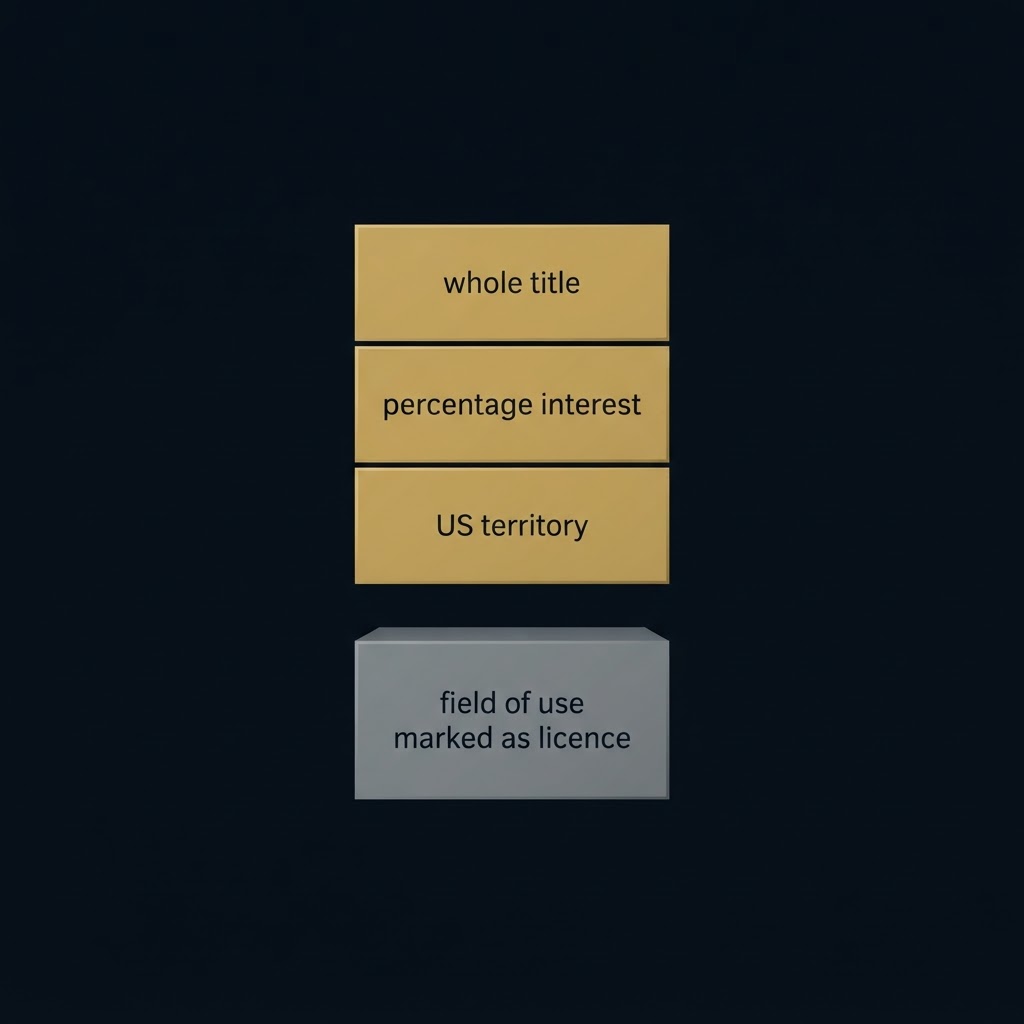
An assignment of patent rights agreement is the deed of a patent. It is the one document that moves ownership from one party to another, and most of the templates online get the form right and the substance wrong. They let you type a percentage into a blank without telling you what a percentage does. They never mention that a territory can be assigned but a field of use cannot. And they say nothing about the documents that look like assignments, get recorded like assignments, and transfer no title at all. This guide reads the agreement the way a patent buyer reads it: what it can move, what it cannot, which clauses carry the weight, and the recording step that decides who wins if the same patent is sold twice. US law first, then the European Patent Office. ## What an assignment of patent rights agreement actually is US regulations define an assignment as a transfer by a party of all or part of its right, title and interest in a patent or patent application. The Manual of Patent Examining Procedure adds the part that matters: the transfer must include the entirety of the bundle of rights attached to the share being transferred. You can hand over all of the patent or a percentage of it, but whatever share you hand over goes with every right it carries. That is the line between an assignment and a licence. A licence keeps title with the owner and lends out some of the rights: a market, a product category, a term of years. An assignment changes whose name is on the register. Think of a building. A licence rents floors. An assignment sells the building, or a share in it. Two formal rules sit underneath. The agreement must be in writing, because applications, patents, or any interest therein are assignable in law by an instrument in writing. And the Office that records it does not check it. Recording is a ministerial act, not a ruling on whether the document is valid or what it did to ownership. ## Three things the agreement can move ### Whole title The clean case. The assignor conveys the entire right, title and interest in the patent or application, for the full term, including reissues, extensions, continuations and divisions. The standard template language runs that the rights are to be held by the assignee as fully and exclusively as the assignor would have held them had the assignment not been made. After signature the assignor has nothing left to license, sell or enforce. This is what a buyer expects when it pays a purchase price, and anything less needs a reason. ### A percentage interest The templates allow a number below 100. What they do not say is what the number creates. A partial assignment makes the buyer a partial assignee and turns the patent into jointly owned property. Under US law, absent an agreement to the contrary, each of the joint owners may make, use, offer to sell, or sell the patented invention without the consent of and without accounting to the other owners. Read that twice. A 20 percent co-owner can license the whole patent to your biggest competitor and keep the money. A 50 percent assignment is not half the value of the patent. It is a second owner with a full set of keys. The rule compounds: each inventor can only assign the interest that inventor holds, so an assignment by one joint inventor produces a partial assignee, and a partial assignee can only pass on what it has. Before the Office, all owners must act together as a composite entity, and partial assignees have to state their percentage so the shares account for the whole. Percentage assignments exist for good reasons, usually a co-development deal or a founder split. They need a co-ownership agreement on top, covering who may license, who enforces, and how proceeds split. Without one, the statute's default applies, and the default is every owner for themselves. ### An exclusive right in a specified part of the United States The statute allows one more carve. The owner may grant and convey an exclusive right under the patent to the whole or any specified part of the United States. A territorial grant can therefore be an assignment in its own right. Field of use is different. Nothing in the statute lets you assign the patent for medical devices and keep it for consumer goods. A split by industry, application or customer type leaves the owner holding part of the bundle, so it is a licence, however exclusive its wording. That distinction is the basis of how we structure rights sales at EX-IX. Rights carved by industry, territory or field of use are sold or licensed while title stays whole. A buyer in automotive gets exclusivity in automotive. A buyer in agriculture gets agriculture. Neither becomes a co-owner, which means neither inherits the problem in the previous section. ## Security interests, licences and liens: recorded, but not assignments The USPTO assignment register holds more than assignments. Licence agreements and agreements which convey a security interest are recorded in the public interest, to put third parties on notice of equitable interests in a patent. Attorney's liens are refused. The cover sheet that accompanies any recorded document lists the kinds of conveyance the Office expects to see: assignment, security agreement, merger, change of name, license, foreclosure, lien, contract and joint research agreement. So a search of the register that turns up a "security agreement" against a patent does not mean the patent has changed hands. It means a lender holds a claim on it as collateral. Title is still with the borrower. For a seller this is a disclosure item: a recorded security interest has to be released before closing, or the buyer takes the asset subject to the lender's rights. For a buyer it is a checklist line that is cheap to run and expensive to skip. The Office is explicit that recording a document is not a determination of its effect on the chain of title. That determination is made only when someone needs to establish ownership to act before the Office. Until then the register is a notice board, not a judgment. ## The clauses that do the work Stripped to its load-bearing parts, a US assignment of patent rights agreement needs the following. The sample forms published by Nolo show the conventional wording for each. | Clause | What it must do | Where it goes wrong | |---|---|---| | Parties | Name the assignor and assignee with legal entity names and addresses | A trading name or a founder signing personally for a company | | Identification | Patent or application number, filing date, title; schedule for multiple assets | Omitting continuations, divisions, reissues and foreign counterparts | | Consideration | State that value was given and received | Zero consideration between unrelated parties | | Rights transferred | All right, title and interest, or a stated percentage, or a specified US territory | A field of use limit, which turns the document into a licence | | Operative words | Present tense: "hereby assigns" | "Agrees to assign", which is a promise and not a transfer | | Warranties | Assignor owns the rights and has not previously licensed, pledged, assigned or encumbered them | Silence about a recorded security interest | | Further assurances | Assignor will sign further papers and testify to help secure and enforce the rights | Missing, so an uncooperative inventor can stall prosecution | | Issue authorization | Authorizes the USPTO to issue any resulting patent to the assignee | Missing on an application assignment | The issue authorization line is more than boilerplate. If multiple assignees hold the entire interest, the patent may issue in their names; if assignees and an inventor together hold it, it may issue in the names of both. The Office only does that if the assignment has been recorded, so the clause and the recording work together. ## Signing, acknowledging and recording ### United States The agreement is valid once it is in writing and signed. Notarization is not required, a point covered in detail in our answer to does a patent assignment need to be notarized. What a notarial acknowledgment adds is evidential weight: a certificate of acknowledgment is prima facie evidence that the assignment was executed, which shifts the burden to anyone who later challenges the signature. Recording is where the real protection lives. An assignment is void as against a later purchaser or mortgagee for value without notice unless it is recorded within three months of its date or before that later purchase. Sign on the first of the month, sit on it, and a buyer who acquires the same patent from the same seller in month five and records first will take priority. The cover sheet is short: conveying party, receiving party and address, nature of the interest, each application or patent number, correspondence address, execution date and the submitter's signature. There is no reason to wait. ### European Patent Office For a European patent application the rule is tighter on form and silent on notaries. Article 72 of the European Patent Convention requires the assignment to be made in writing and signed by the parties to the contract. Both parties, not just the assignor. A one-sided deed that satisfies a US assignment branch can fail at the EPO. Registration of the transfer then follows the Guidelines on the documents the Office accepts as evidence, and until it is registered the EPO continues to deal with the previous applicant. For a family prosecuted on both sides of the Atlantic, draft once to the stricter standard: both signatures, dated, with the application numbers of every member listed in a schedule. ## How a buyer reads your assignment chain When a patent comes to our brokerage desk, title is checked before value. A patent with a broken chain is not worth less; it is not sellable until the chain is fixed. The usual breaks are the ones this article has walked through. An inventor who never signed the invention assignment agreement to the company, so the company is a partial assignee. A percentage split from an old co-development deal with no co-ownership terms. A security interest recorded by a bank the founders forgot about. A foreign counterpart that was never assigned because the original deed only named the US application. Each of these is repairable, and repairing them is the first week of work on most mandates. Our brokerage is success based: the commission is paid by the seller on completion, with a minimum fee of EUR 5,000 per completed transaction, so a chain of title problem that stops a sale is our problem as much as the seller's. For anyone weighing the broader route, our guides on selling patent rights and the best way to sell a patent cover what happens after title is clean, and a companion piece on the general patent assignment agreement covers the employment and founder context. One caveat, stated plainly. EX-IX is not a firm of patent attorneys. Filings on our drafting side go through an independent licensed patent attorney of record, and an assignment that moves real value deserves the same. This article explains the mechanics. It is not legal advice for your deal. ## FAQ ### Can you assign a patent application before the patent is granted? Yes. The statute makes applications assignable by written instrument on the same footing as granted patents. The assignment should identify the application by serial number and filing date, cover continuations and divisions, and authorize the USPTO to issue any resulting patent to the assignee so the grant comes out in the right name. ### Can an assignment be limited to one field of use? No. An assignment has to carry the entire bundle of rights for the share transferred. A limit to a specified part of the United States is expressly allowed and still counts as an assignment. A limit by industry, product or application leaves rights with the owner, which makes the document an exclusive licence regardless of its title. ### What happens if the same patent is assigned twice? The first assignment is void against a later purchaser for value who had no notice, unless the first was recorded within three months of its date or before the second purchase. In practice the party who records first and in good faith keeps the patent, and the first buyer is left with a claim against the seller. ### Does the USPTO check that an assignment is valid when it records it? No. Recording is ministerial. The Office files the document and the cover sheet and gives the public notice that it exists. Whether it validly transferred title is decided only when ownership has to be established, for example when the assignee tries to act in the application. ### Who has to sign an assignment of a European patent application? Both parties to the contract. Article 72 EPC requires the assignment to be in writing with the signature of the parties, so an assignee's countersignature is mandatory, not a formality.
We use essential cookies to operate this website and, with your consent, optional cookies to understand site usage. You can accept or decline non-essential cookies at any time. See our Impressum for our contact and legal details.