 October 2026
Patent Portfolios for Sale: Where Listed, How Priced
Search for patent portfolios for sale and you land in a shop window: broker inventory pages, a few open marketplaces, long lists of technology categories. What none of those pages tells you is how big the shop behind the window is, what the goods actually cost, or how a listing turns into a signed assignment.
That is what this guide covers. The numbers come from the most complete public dataset on the brokered patent market, and the listing examples come from the pages that rank for this search today. Whether you are an IP team shopping for coverage or an owner deciding where to put a portfolio, the logic is the same: a listing is a teaser, not a price tag.
Where patent portfolios for sale are actually listed
The secondary market is small and concentrated. Richardson Oliver Insights tracked 1,611 packages in 2024 holding 22,795 patent assets, put that year's sales at USD 158 million, and found a broker involved in 87 percent of every package that sold. The same report is explicit that it sees the public packages and only some of the private ones, so even those counts undercount the market.
Portfolios reach buyers through three channels.
Broker inventory pages
Most of what ranks for this search is broker inventory. Vitek IP lists each portfolio as a patent count, a family count and an expected transaction quarter. RZV offers its portfolios for acquisition or licence and says how many claim charts sit behind an NDA. Tangible IP presents premium offerings as named technology portfolios, from UAV delivery to EV charging control.
Read the small print on these pages. TransactionsIP lists only packages whose sellers have not asked for confidentiality and will only represent a seller who holds at least one issued US patent. IPOfferings states the same anonymity rule. What you see on a broker page is the part of the inventory the sellers were happy to show.
Open marketplaces
Open platforms let anyone browse. IAM Market is free for buyers and licensees and tags each listing as licence, sale or both, with an asset count. IP Nexus showed 68,028 patents and 194 patent portfolios on its exchange when we checked, a mix that runs from software portfolios to single design patents for gloves. Volume is high; vetting is whatever the seller chose to provide.
Private packages you will never see on a page
Some brokers only shop a package to a handful of buyers, and those deals never appear publicly. Consortium programmes run on their own rails too: the ROI report describes Allied Security Trust's IP3, where sellers name a fixed price and member companies decide on an accelerated schedule whether to buy or license. If you are buying, the listing pages are the starting point, not the full market.
To see what actually changed hands, look at recorded assignments rather than listings. GTT Group publishes a running feed of recorded acquisitions, for example Boston Dynamics acquiring from Google, recorded on 8 October 2026.
How to read a portfolio listing
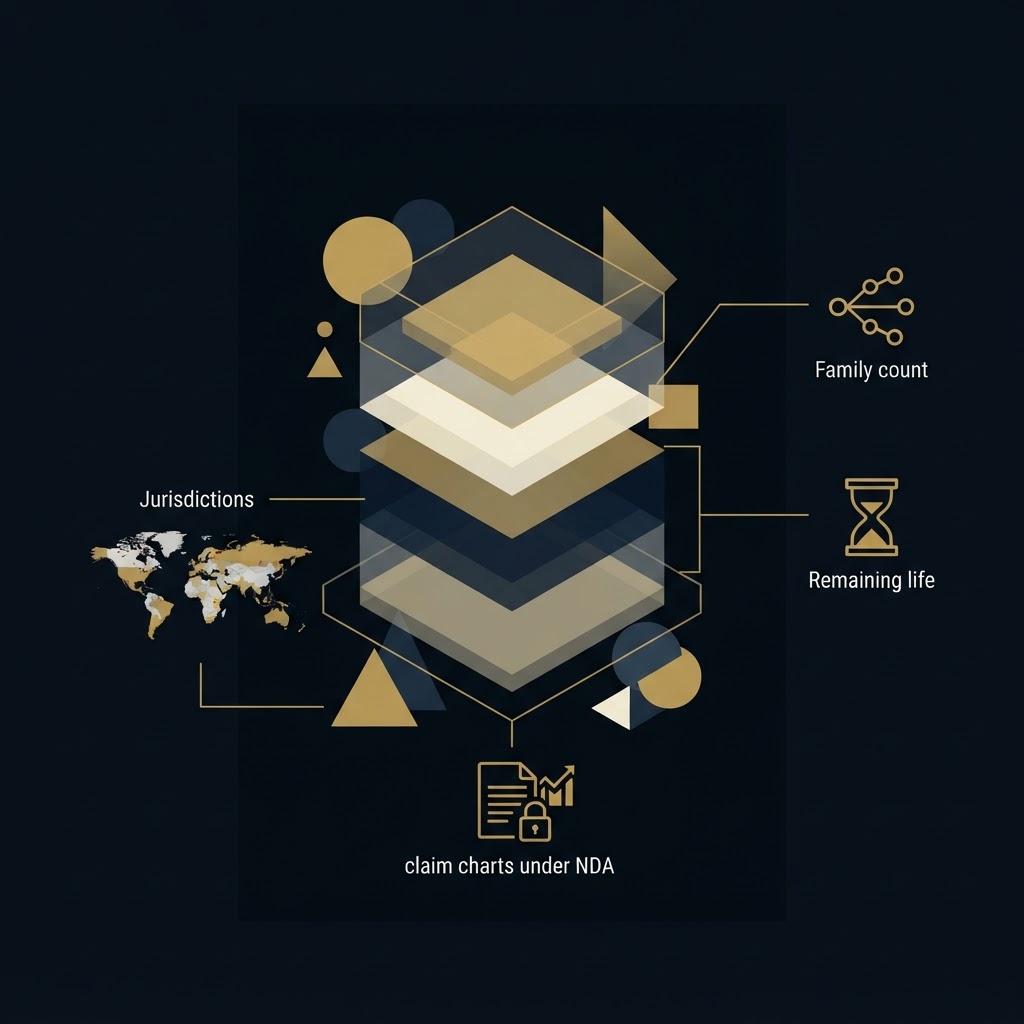
A listing line is dense. Four fields carry most of the meaning.
Patents, families and assets are not the same count
A family is one invention filed in several jurisdictions or continuations; an asset is each individual patent or application. Vitek's Verizon Jaunt XR portfolio is 160 patents in 94 families and is marked partially sold. RZV's 3D display offering is 18 families with 27 active assets. Price and diligence effort track families more than raw patent counts, so convert every listing to families first.
Most packages are small. ROI found an average of 14 assets per package but a median of two, and 85 percent of 2024 packages held 10 or fewer US issued patents. A "portfolio" on these pages is often a pair of related patents.
Remaining life, priority date and jurisdictions
GreyB's listings show protected jurisdictions, priority date, remaining life and citation count for each set, with further detail released after an NDA. These fields answer the first buyer question: how long is the exclusivity, and where does it bite? A US only family with three years left is a different asset from a US, EP, CN family with twelve.
Claim charts and evidence of use
Evidence of use (EOU) is a claim chart showing a product that appears to practise the claims. It is the single biggest price lever in the market. In ROI's data only 21 percent of 2024 packages came with EOU, yet over five years EOU packages commanded price premiums of 32 to 108 percent and sold more often. When a listing says "claim charts available under NDA", that is a signal the seller has done the work.
Status words
"For sale" means open. "Licensed" means the seller took a licence deal instead of a sale. "Sold" on a broker page is a track record signal. "Transaction anticipated Q3" is the broker's target close, not a deadline. Also note that ROI counts a package as sold if any single asset in it sells, so partially sold portfolios are common and the best patents may already be gone.
What patent portfolios sell for
Asking prices in 2024
ROI's Table 3 gives median asking prices for everything listed and, separately, for the assets that actually sold.
| Median asking price (2024) | All listed | Sold |
|---|---|---|
| Per patent asset | USD 163,000 | USD 95,000 |
| Per US issued patent | USD 286,000 | USD 141,000 |
| Per patent family | USD 325,000 | USD 158,000 |
The gap between the two columns is the first lesson. The packages that sell were asking a little over half the overall median.
Asking is not closing
These are still asking prices. ROI's closing price studies show discounts of 0 to 75 percent or more, and the discount grows the longer a package sits. Patience is part of the market: packages first listed in 2019 have only now reached a 30 percent sold rate. For a buyer, an old listing is a negotiating opportunity. For a seller, it is a warning about pricing high and waiting.
Why bigger portfolios cost less per patent
Price per asset falls as package size rises, and buyers also cap total spend. ROI sees a clear preference for deals priced between USD 250,000 and USD 1 million, notes that signing authority tends to stop around USD 2 million, and that a USD 50,000 deal is too small to move a typical corporate seller through its approval process. That is why sellers split large portfolios into small, themed packages.
Pricing is often missing altogether. Only about 40 percent of packages carry any pricing guidance, and buyers tend to deprioritise the rest. To set your own range, start with how much a single patent can sell for and the patent valuation methods brokers and buyers use.
Who buys portfolios, and who sells them
The buyer side is covered in depth in who buys patents and what each buyer pays for. In short, from 2020 to 2024 operating companies bought 15 to 40 percent of packages and 37 to 90 percent of assets, NPEs bought 11 to 50 percent of packages, and defensive aggregators bought 20 to 40 percent of packages but only 2 to 22 percent of assets.
On the sell side, operating companies supplied 37 percent of packages and 72 percent of sold assets, and repeat sellers can account for more than 40 percent of available packages in a year. Individual inventors find it hardest to sell. Distressed sellers are a category of their own, covered in patent portfolios from bankrupt companies.
One number buyers should carry into diligence: 22 percent of sold packages were litigated, against 3 percent of unsold ones. Know what you are buying into, and who held it before.
How a portfolio purchase runs, from teaser to assignment
- Teaser. A listing or an anonymous summary: technology, family count, jurisdictions, remaining life.
- NDA. Claim charts, EOU and the full patent list are released only under confidentiality.
- Data room and diligence. Prosecution history, maintenance status, chain of title, prior licences and encumbrances, plus your own validity and infringement read.
- Offer and negotiation. Price, which assets transfer, licence back terms for the seller, and whether you buy outright or license instead. ROI reports that several leading brokers now offer a licence if you do not want to buy.
- Assignment and recordal. A signed assignment, recorded at each patent office so the new owner appears on the register.
Brokers usually run this process on contingency; TransactionsIP, for example, works primarily that way. To see what that role involves and what it costs, read what a patent broker does and what patent brokers charge.
If you are selling: get the portfolio onto the right list
The data points to three moves that get a portfolio sold.
Prune before you list. Drop families with little remaining life or no commercial reading, and package what is left in small, themed sets. Patent portfolio pruning covers how to decide.
Price it and chart it. A listing with an asking price and at least one claim chart gets read. One without either joins the roughly 60 percent of packages with no pricing guidance, the ones buyers tend to deprioritise.
Use a broker who vets before listing. At EX IX the brokerage is success-based: commission is paid by the seller on completion, with a minimum fee of EUR 5,000, so no sale means no fee. Before a patent reaches a buyer, it goes through a digital twin validation gate covering claim reconstruction, detectability analysis and validity probability. That process improves the teaser a buyer sees. It does not guarantee a sale or a price, and nobody honest can.
FAQ
Can an individual buy a patent portfolio?
Yes. Open marketplaces such as IAM Market are free for buyers, and nothing stops a private buyer from making an offer. Expect to sign an NDA before seeing claim charts, and expect brokers to ask what you intend to do with the patents.
Why do so many listings say "price on request"?
Because most sellers never set one. Only about 40 percent of packages carry pricing guidance, while auction listings are always priced and packages with EOU include a price more than twice as often. Buyers often read "no price" as "unrealistic seller".
Can I buy only some patents out of a listed portfolio?
Often, yes. Partial sales are common enough that ROI counts a package as sold when any one asset sells. Ask the broker which families are still available before paying for diligence on the whole set.
How do I check whether a listed portfolio has already sold?
Check the assignment records at the patent office, or a recorded acquisitions feed such as GTT Group's. Broker pages also mark portfolios as sold or licensed, though not always promptly.
We use essential cookies to operate this website and, with your consent, optional cookies to understand site usage. You can accept or decline non-essential cookies at any time. See our Impressum for our contact and legal details.