 October 2026
Patent Licensing Companies: Who They Are and Which Fits
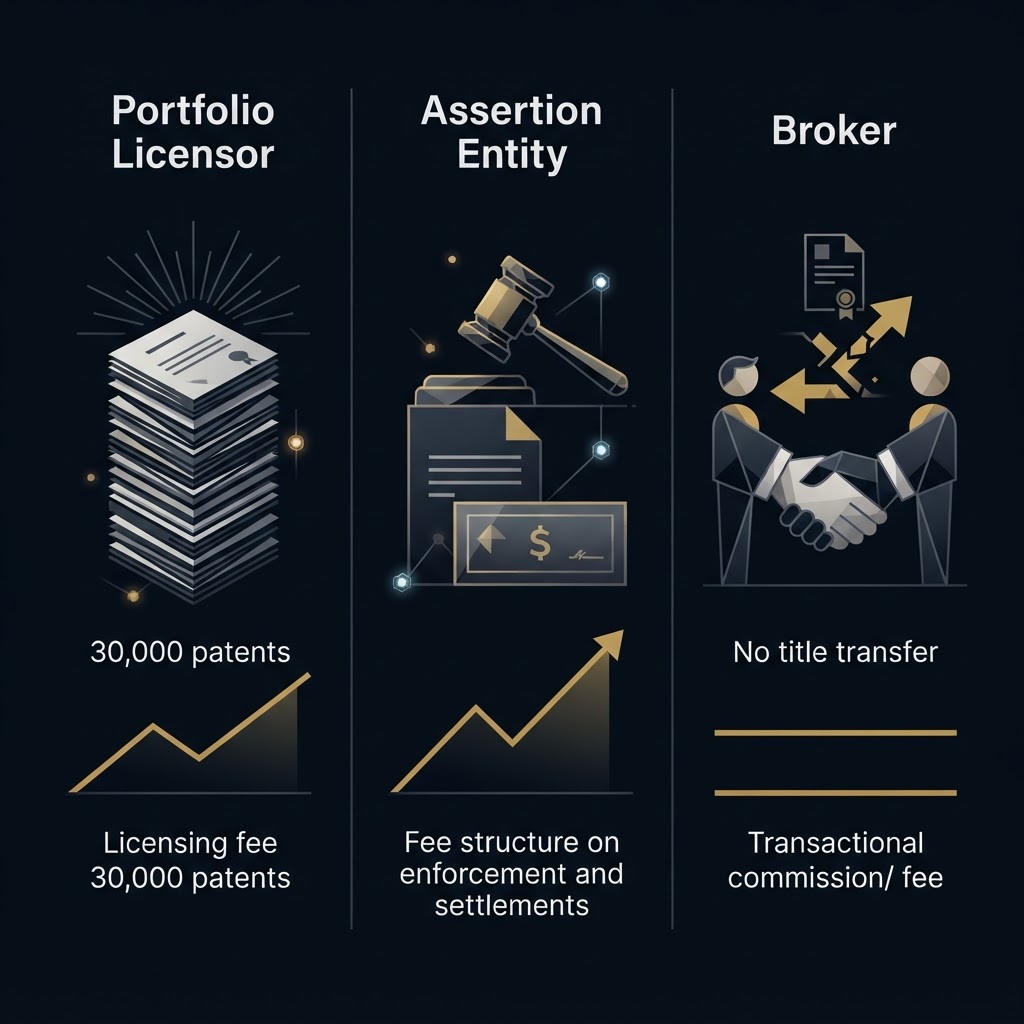
Search for patent licensing companies and you get two kinds of page: a directory of firms with tens of thousands of patents, and a broker explaining why it is better than the other brokers. Neither tells you the thing you need to know first, which is that the phrase covers three different businesses. One buys whole portfolios and licenses entire industries. One buys small lots of patents and sues. One takes no title at all and works for a commission. They have different economics, different minimum deal sizes, and different answers to the question of whether they would ever take your patent. This article sorts them using the public numbers, mostly the US Federal Trade Commission's study of the sector and the annual brokered-market reports, and then says plainly which category an individual inventor, a spinout or a small company can realistically approach. We run a brokerage ourselves, so we state where we sit and where we do not fit. ## Three businesses hide behind one label The FTC defines the second category precisely. Patent assertion entities are businesses that acquire patents from third parties and seek to generate revenue by asserting them against alleged infringers; they monetize primarily through licensing negotiations, infringement litigation, or both, and do not rely on producing or selling goods. The study found that this single definition splits into two business models so different that they barely belong in the same sentence: Portfolio PAEs and Litigation PAEs. We treat them as the first two categories below. The third category is the intermediary. A patent broker analyses the assets, prepares a portfolio for marketing and sale, contacts prospective buyers and assists until a transaction closes; most represent the seller, and because the industry is unregulated, anyone can claim to be one. Licensing advisory firms are a variant that runs a licensing programme on your behalf rather than a sale. One advisory firm puts the sorting principle well: the category decides whether the firm's financial success requires your financial success. That is the right test. Everything below is an attempt to apply it with numbers rather than adjectives. ## Portfolio licensing companies: the ones holding 30,000 patents ### Who they are These are the names that fill the directory pages. Intellectual Ventures holds 40,000 or more patents across software, hardware and biotech; InterDigital holds 30,000 or more patents and applications in wireless, video and AI; Acacia Research runs 200 or more licensing programmes; Fortress Investment Group has USD 2.9 billion committed to IP; WiLAN holds 3,300 or more patent assets. Some of these started as operating companies and kept the research arm after the product business faded. Some were built as licensing businesses from day one. Some are funds. ### Why a single patent is rarely their unit of trade The FTC data explains their behaviour. Portfolio PAEs negotiate licences covering hundreds or thousands of patents, frequently without first suing, and the licences are typically worth millions. They accounted for only 9 percent of the licences in the study but generated 80 percent of the revenue, approximately USD 3.2 billion, and they funded their acquisitions with capital raised from institutional investors and manufacturing firms. Read that as an owner. A company whose average licence covers a sector, and whose balance sheet was raised from institutions, buys portfolios that plug a specific gap in a specific programme. It does not browse. If your patent happens to read on a standard that one of these firms is already licensing, you may get a call, and the deal will be structured around their programme rather than your asset. If it does not, your patent is below the unit of trade, and no amount of outreach changes that. ## Patent assertion entities: what the economics actually look like ### The litigation model in numbers The second business model is the one the word "troll" was coined for. Litigation PAEs sue potential licensees and settle shortly afterward with licences covering small portfolios. The FTC found that for each acquired portfolio they typically created a new affiliate holding ten patents or fewer, operated with little or no working capital, and funded themselves through agreements to share future revenue with the patent sellers. They filed 96 percent of the cases in the study and signed 91 percent of the licences, but generated only 20 percent of the revenue, approximately USD 800 million. Their licences typically yielded less than USD 300,000 in total royalties, which one estimate puts at the lower bound of the early-stage cost of defending a patent suit. That last number is the whole model in one line. The licence is priced at the defendant's cost of fighting, not at the value of the invention. The share of the market this model takes is large. Across all sectors NPEs are responsible for almost 60 percent of patent litigation, and within high technology as much as 88 percent, with suits rising since 2016 on the back of assets for sale on the open market and the availability of litigation funding. On the buy side of the brokered market, 67 percent of purchases in 2020 were by NPEs, up every year since 2016, while corporate buying fell to 27 percent from 39 percent. For a patent listed through a broker today, the most likely buyer is an assertion entity. ### What reaches the inventor The model is funded by the seller's own revenue share, so the question is how much comes back. The best-known academic estimate is unflattering: the direct costs of NPE assertions to defendants were USD 29 billion in 2011, most of the defendants were small or medium-sized firms, and an examination of publicly listed NPEs indicates that little of those costs represent a transfer to small inventors. The advisory side of the industry describes the terms the same way: PAEs typically take ownership or exclusive control of the patents, carry the enforcement costs, and split proceeds, often 50/50 or worse for the holder, over timelines that stretch to years rather than months. The honest caveat is that for some assets this is the only buyer there is. A patent with strong evidence of use against a large defendant and no operating business behind it is worth more to a litigation entity than to anyone else, and an owner who cannot fund an enforcement campaign may rationally take the split. Just understand what you are selling: the right to be sued, priced at somebody else's legal budget, with your proceeds arriving if and when the campaign succeeds. ## Brokers and licensing agents: no title, a commission ### What a broker does and charges The third category is the one that represents you rather than buying from you. We have written separately on what a patent broker is and on how much patent brokers charge, so here are the headline economics. Traditional brokers charge 25 to 35 percent commission, take 6 to 18 months to close, typically only accept patents with an estimated value above USD 500,000 to 1 million, and accept roughly 5 to 10 percent of the patents submitted to them, on an exclusive listing agreement. Two of those numbers matter more than the commission. The threshold means that a broker's first job is to decline you, and the acceptance rate means it does so nine times in ten. A broker that accepts everything is either a bulletin board or has no buyers to protect. The IAM guidance on vetting is still the best short test: ask for specifics of recent transactions, because many who call themselves brokers have zero or very few sales, and ask how many prospects the broker will actually contact and whether it knows them, because patent sales are relationship driven and a numbers game. ### How small the brokered market really is The brokered market is thinner than the industry's marketing suggests. Stanford's Mark Lemley notes that estimates are hard because most transactions are private and sale prices are rarely reported, and that the brokered, quasi-public market was estimated at approximately USD 230 million of annual sales for 2015. The following year the value of the brokered market fell to USD 165 million, corporate purchases exceeded NPE purchases for the first time, RPX overtook Intellectual Ventures as the leading buyer, and the Supreme Court's Alice decision crushed much of the fintech patent market and hit software sales rates. The broker population reflects that. In 2020 the number of brokers listing packages dropped to 42 from 47, 12 of those brought ten or more packages and accounted for 89 percent of broker-listed packages, and for-sale-by-owner listings rose to 7.1 percent from 4.5 percent. A dozen firms do most of the work, and a growing share of owners skip them entirely. ## Where EX-IX fits, and where it does not We sit in the third category, with two differences in process. EX-IX runs an M&A-style sale of third-party patents: valuation, buyer targeting, controlled outreach and deal support, with a success commission paid by the seller on completion and a minimum fee of EUR 5,000 per completed transaction. No sale, no fee. The rights we hold ourselves are sold or licensed carved by industry, territory or field of use, so a buyer that needs one application does not have to negotiate for the whole family. The first difference is the gate. Before any patent reaches a buyer it goes through digital-twin validation: physics-grade claim reconstruction, detectability analysis and a validity probability, benchmarked at 0.76 percent mean absolute percentage error against real-world outcomes. That is our answer to the acceptance-rate problem. Rather than declining nine in ten on a valuation threshold, we test the claims and send buyers only what survives. The second is that we are also an owner. The group has 24 patent families filed or in progress and around 100 inventions identified and validated in the pipeline, so the buyer relationships exist because we use them for our own assets, not only for clients. Where we do not fit is just as important. EX-IX does not litigate and does not buy patents to assert them, so if your asset's only value is an infringement case against a large defendant, a litigation entity is the right counterparty and we will say so. We are not a firm of patent attorneys, and a filed application is not a granted patent; a pending family is priced as pending. ## A screening checklist before you sign with any of them Six questions separate the three categories faster than any brochure. - Who pays them, and when? A broker is paid by you on closing. A PAE pays you a share of what it collects, if it collects. A portfolio licensor pays once, for the asset, at its price.
- Does title move? Brokers take none. Assertion entities take ownership or exclusive control. If title moves before money does, you are the financing.
- What happens if it does not sell? Ask how an exclusive listing ends and whether the patent comes back unencumbered, with no lingering rights for the firm.
- What are the last three transactions? Specifics, not a logo wall. Unregulated industry, so this is your only due diligence.
- What is the litigation posture? A firm whose revenue is settlements priced at defence costs will treat your patent as a lawsuit. Decide whether that is what you want your name on.
- What is the minimum? Thresholds of USD 500,000 to 1 million are normal for brokers, and portfolio buyers trade in sectors. If you are below both, the question becomes whether to license or sell your patent yourself, and for spinouts, what the university patent licensing fees in your agreement already commit you to. ## FAQ ### Are patent licensing companies the same as patent trolls? No. "Troll" is slang for the litigation model, where a firm buys a small lot of patents and sues to settle. The FTC study separates those from portfolio licensors, which negotiate licences worth millions, often without suing, and which generated 80 percent of the revenue it measured. Brokers are different again, since they take no title and are paid by the seller. ### How much do patent licensing companies take? It depends on the category. Traditional brokers charge 25 to 35 percent of the sale price on success. Assertion entities take ownership and split proceeds, often 50/50 or worse for the holder. EX-IX charges a success commission paid by the seller on completion, with a EUR 5,000 minimum, and nothing if no sale closes. ### Will a licensing company take a single patent from an individual inventor? Portfolio licensors rarely will, because their unit of trade is a sector-wide programme. Brokers accept roughly 5 to 10 percent of submissions and usually require an estimated value above USD 500,000. Litigation entities do take small lots; the FTC found their affiliates typically hold ten patents or fewer, which is the one category where a single strong patent is a normal deal. ### Is it better to sell to a licensing company or license the patent myself? If you can identify and sign licensees yourself, you keep the whole royalty and the title. If you cannot, a broker finds a buyer for a commission, and an assertion entity pays you a share of settlements that the FTC found typically total under USD 300,000 per licence. The decision turns on whether you have buyers, time and an enforcement budget of your own.
We use essential cookies to operate this website and, with your consent, optional cookies to understand site usage. You can accept or decline non-essential cookies at any time. See our Impressum for our contact and legal details.