 October 2026
License or Sell Your Patent? The Decision, With Numbers
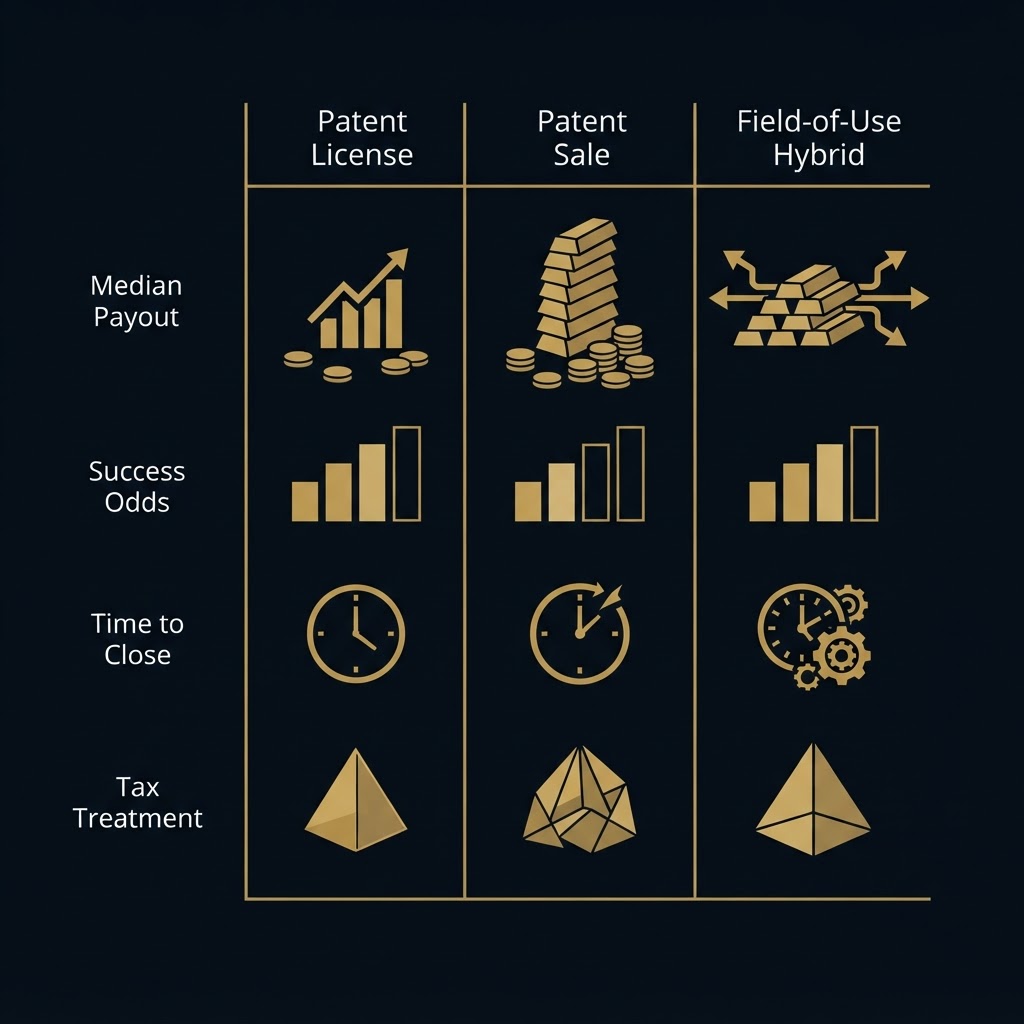
Should I license or sell my patent? Every page that ranks for the question gives you a framework and then tells you it depends on your goals. Licensing means ongoing income and control. Selling means a clean break and cash now. Pick the one that matches your personality. That is a quiz, not a decision. A decision needs numbers: what a licence actually pays, what a sale actually fetches, how often each one happens at all, how long each takes, and what the tax line looks like. Those numbers exist. Almost nobody attaches them to the choice. This is the broker's version. The short answer first, then each path with its economics, then the six questions that decide it, then the hybrid most inventors never hear about. ## The short answer Sell when you need certainty, when you cannot fund enforcement, or when the patent covers a field you will never enter. License when a company already wants to use the invention, you can carry months of negotiation and years of administration, and you can afford to defend the patent if the licensee stops paying. Most inventors with one good patent should look at the third option before either: carve the rights by field of use or territory, sell the slice you will never use, license the slice that pays, and keep the slice your own product needs. Title stays whole. The choice stops being binary. ## What each path actually is ### Selling is an assignment A patent sale is legally an assignment. It is a permanent transfer of ownership, analogous to selling real estate: once completed, you have no further rights unless the agreement expressly reserves a licence back to you. Under US law the assignment must be in writing under 35 USC 261, and the buyer should record it with the USPTO within three months to protect against a later purchaser. Assignments can be partial. You can transfer rights for one country and keep others, or transfer one field of use and keep the rest. That detail matters later. ### Licensing is permission with the title kept A licence grants someone permission to practise the invention while you keep the title. You can grant further licences, enforce the patent yourself and get the rights back when the term ends. Nolo's long-standing guide calls licensing or assigning the simpler, less expensive route compared with manufacturing, and puts typical royalties at 2 to 10 percent of net revenues. One patent attorney describes licensing as the most common way to monetize a patent, with the central structural choice being exclusive (one licensee, higher fees) or non-exclusive (several licensees, often in different sectors). For how the rights bundle splits in practice, see selling patent rights in pieces. ## The economics, side by side ### What a licence pays The best public benchmark is the Licensing Executives Society survey of real deals. In the 2021 round, patents appeared in 72 percent of reported deals, 41 percent of deals used a royalty on sales, 34 percent used a lump sum, and the median lump sum was 125,000 USD, a new low after years of decline. The royalty rates in that survey averaged 4.82 percent with a median of 4.75 percent of the licensee's sales. So a licence is roughly 5 percent of someone else's revenue for as long as the patent lasts and the licensee keeps selling. If the licensee sells 2 million a year, that is about 100,000 a year. If they sell nothing, it is nothing. The royalty is a share of a business you do not control. We break the rates down by sector in average patent licensing royalty rates. ### What a sale pays Across US patent transactions tracked by Richardson Oliver, the median sale sits around 77,000 USD, with the top quartile far higher and elite assets in AI and semiconductors above a million. Closing prices in the brokered market run 25 to 55 percent below asking, with the discount growing the longer a package sits, and the same report says plainly that individual inventors have a harder time selling than operating companies do. Put the two medians next to each other and the comparison the SERP never makes appears. The median lump sum in a licensing deal is bigger than the median patent sale. One licensing advisor argues that a well-structured licence generates 3x to 10x more cash over a ten-year life than the equivalent lump-sum sale and that founders should license by default. That multiple is the advisor's own, not survey data, and it assumes a licensee exists and pays. Which brings us to the number that actually decides most cases. For the full price picture, read what patents actually sell for. ### How often each one actually happens Licensing pays more per deal. It also fails more often than anyone selling licensing services will tell you. A study by Zimmer and Westrum, cited by Nolo, found that only about 13 percent of inventors who tried to license their invention succeeded, and Nolo notes the figure is probably flattering because inventors who failed were less likely to answer the survey. Selling is not easy either. Brokered packages listed from 2016 to 2020 sold 21 percent of the time, and packages that came with pricing guidance sold at 30 percent against 18 percent for those without. Brokers were involved in 87 percent of the packages that did sell. We go through those odds in detail in how hard it is to sell a patent. Read the two rates together. A licence is worth more if it lands. A sale lands more often, closes once, and does not depend on the counterparty's sales for the next decade. ### How long each one takes The same advisor's experience is that a sale closes in about 90 days while a licence takes 4 to 12 months of negotiation, enforcement planning and ongoing administration. Our experience matches the shape if not the exact numbers: a sale is one negotiation and one signature, a licence is a relationship with audit rights, reporting and the question of what happens when the royalty cheque is late. Both timelines start only once a counterparty exists, and finding one is most of the work in either path. ## Six questions that decide it The best structure on the SERP comes from a marketplace guide that gates the whole decision on four questions: does anyone practise the claims, how much term remains, can you fund enforcement, and do you need certainty or upside. We use those four and add two. ### 1. Does anyone practise the claims? This is the gate. A patent nobody infringes has no licensee, because there is nobody to license, and no buyer motivated by risk. If the answer is no, both paths weaken sharply, and the honest options are to hold and watch the market, or to stop paying renewal fees. ### 2. How much term is left? Under three years of remaining term, buyers discount heavily. A licence on a patent with two years left is barely worth negotiating. If the clock is short, sell if you can, and sell soon. ### 3. Can you fund enforcement? A licence is only as strong as your willingness to sue a licensee who stops paying or a competitor who ignores the patent. The first-ranking page for this question says it directly: licensing success depends heavily on your patent's strength and your ability to negotiate and enforce agreements. If you cannot fund enforcement, a threat you cannot execute weakens every negotiation. The marketplace guide draws the same conclusion: sell appears in its table wherever funding is the constraint, which is the ordinary position for individuals and small companies. Converting the patent into an asset someone else can enforce is usually worth more than holding it. ### 4. Do you still need the rights yourself? If your own product depends on the patent, a full sale is a mistake unless the agreement reserves a licence back. A licence, or a partial assignment that keeps your field, is the default. The law firm explainer above notes that assignments frequently reserve exactly such a licence back to the seller. ### 5. Do you need the money now? Even the advisor who says license by default names three cases where selling wins: you are out of cash within 90 days, the patent covers a non-core line you will never return to, or you cannot afford to enforce it. We would add a fourth: the buyer in front of you is the only serious counterparty you have found in a year. A median licence pays more on paper. A signed assignment pays in fact. ### 6. Is it granted or pending? A pending application can be sold or licensed, but buyers discount pending applications by 40 to 60 percent against granted patents because the claims have not been examined. Selling before grant means selling the uncertainty at a discount. An option or a licence that converts at grant often preserves more value. We cover the timing in selling a pending application. A patent with practised claims, long term, an owner who can enforce and no urgent cash need is a licensing asset, and our parent company's guide to patent licensing strategy is the next thing to read. Flip any two of those and it is a sale. ## The hybrid most inventors never hear about The binary framing hides the structure brokers actually use. Because assignments can be partial by territory or field of use, and because licences can be exclusive in one field and non-exclusive in another, a single patent can be three transactions. Take a sensor patent that reads on medical devices, automotive and consumer wearables. The inventor is building a medical device company. The medical field stays with the inventor. The automotive field, where a tier-one supplier already wants it and the inventor will never compete, is sold outright for cash that funds the medical build. The wearables field is licensed non-exclusively to several brands at a royalty, because none of them needs exclusivity and the aggregate is worth more than any one of them would pay to own it. This is how we structure our own rights. EX IX sells and licenses the patent rights it holds carved by industry, territory or field of use, with the legal title kept whole. It is also the structure we propose to sellers who arrive asking the binary question. The answer to "license or sell" is often "both, by field", and the field you sell is the one you were never going to serve. Two cautions. Field-of-use carving creates an enforcement landscape that needs coordination, because several parties now have an interest in the same claims. And every existing licence survives a later sale, so a buyer of the remaining rights steps into your shoes as licensor. Disclose every licence, every time. ## The tax line and the deadline In the United States, the tax treatment of the two paths is not the same. Under Section 1235 of the Internal Revenue Code, a transfer by the holder of all substantial rights to a patent is treated as the sale of a capital asset held for more than one year, regardless of how long the holder actually held it, and regardless of whether payments are contingent on the buyer's use. A licence that keeps substantial rights produces ordinary royalty income. That is a description of the statute, not tax advice, and German readers face a different regime entirely. Talk to a tax adviser before you sign either document. Our piece on whether renewal fees are tax deductible covers the adjacent question for both countries. The other constraint is time. Routes close over a patent's life. The marketplace guide calls the largest error letting a renewal fee deadline arrive before you have decided, because at that point the only options left are paying or lapsing. If a maintenance fee is due in four months and you have not started either process, you are already choosing by default. ## How we run the decision at EX IX We are a patent M&A firm, not a bulletin board, and the decision above is the first conversation we have with a seller. Before we recommend a sale, a licence or a carve, the patent goes through our validation gate: physics-grade claim reconstruction, detectability analysis and a validity probability. Detectability is the question that answers "does anyone practise the claims", and it decides which path is even open. Our brokerage economics push toward whichever structure closes. The commission is paid by the seller on completion, with a minimum of EUR 5,000 per completed transaction. No sale, no fee. A broker on a success fee has no reason to steer you into a licence that never signs or a sale at half of asking, which is one reason to understand what a patent broker does before choosing one. One limit, stated plainly: EX IX is not a firm of patent attorneys. The assignment or licence itself is drafted and executed through an independent licensed attorney of record. We structure the deal and find the counterparty. Lawyers paper it. If the patent has practised claims, time on the clock and a seller who can wait, we will tell you to license. If it does not, we will tell you to sell, and we will tell you the asking-price discount to expect before you list. If you are still weighing every route, start with how to monetize a patent. ## FAQ ### Can I license a patent and then sell it later? Yes. Existing licences survive an assignment, and the buyer steps into your position as licensor, so a patent with royalty history is often easier to price than one with none. The licences must be disclosed to the buyer, and an exclusive licence will limit what a buyer can do with the asset. ### Is a patent sale taxed differently from royalties in the US? Under Section 1235, a holder who transfers all substantial rights to a patent is treated as selling a long-term capital asset, while royalties under a licence that keeps substantial rights are ordinary income. The distinction turns on what rights you keep, not on what the contract is called. This is a description of the statute, not tax advice. ### Which is faster, licensing or selling a patent? A sale usually closes faster once a buyer exists, often within a few months, while a licence negotiation commonly runs most of a year and continues as an administrative relationship afterward. In both cases, finding the counterparty takes longer than the paperwork. ### Should I license or sell a patent that is still pending? Both are possible, but buyers discount pending applications heavily because the claims have not been examined. If you can carry the prosecution cost, a licence or an option that converts at grant usually preserves more value than selling the uncertainty.
We use essential cookies to operate this website and, with your consent, optional cookies to understand site usage. You can accept or decline non-essential cookies at any time. See our Impressum for our contact and legal details.