 September 2026
Average Patent Licensing Royalty Rates: 3 Benchmarks
Ask five people for average patent licensing royalty rates and you will get five confident answers. Four percent. Five. Ten. Thirteen. A few dollars a unit. None of them is lying. They are quoting different averages, measured on different populations of patents, and the gap between them is large enough to wreck a negotiation before it starts.
A broker does not open with a number. A broker opens by asking which market the number came from. So here are the three benchmarks that matter, what each one actually measures, and which one belongs on your term sheet.
The short answer: three averages, not one
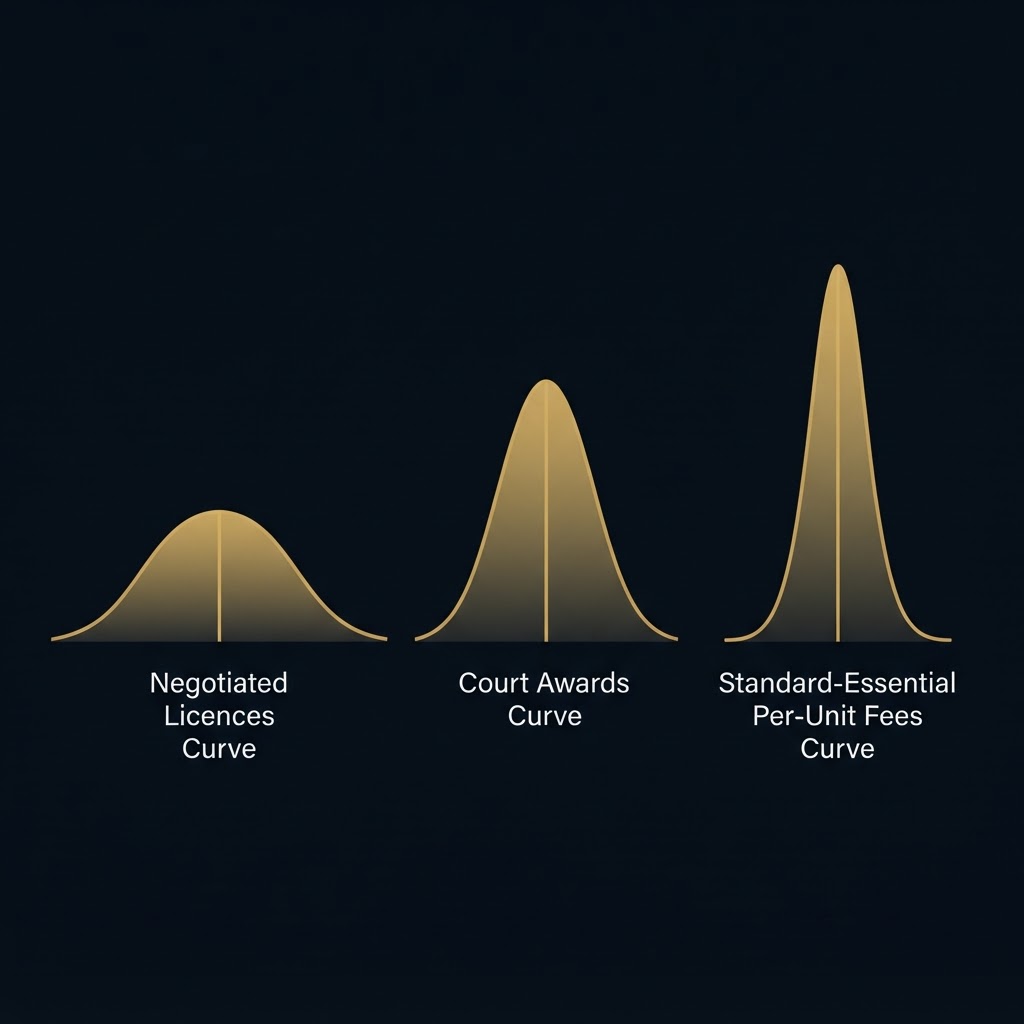
| Benchmark | Typical figure | What it measures |
|---|---|---|
| Negotiated licences (LES surveys) | 4.8% average, 3.77% for patent-only deals | Voluntary deals reported by licensing professionals |
| Court-awarded reasonable royalties | 10% most common, mean above 13% in one study | Patents found valid and infringed at trial |
| Standard-essential patents | Per-unit fees, often a few dollars | Rates on patents built into telecom and vehicle standards |
The negotiated figure is the one most pages quote. In the 2021 Licensing Executives Society survey the average royalty rate was 4.82 percent and the median 4.75 percent, with the average across four surveys since 2011 at 5.66 percent, while deals where patents were the only IP licensed averaged 3.77 percent.
Keep that 3.77 percent in mind. It is the most honest single number in this article for anyone holding a patent family and nothing else.
Average one: negotiated licences
What the LES surveys measure
The survey population is real deal flow, and patents dominate it. In the 2021 round, patents appeared in 72 percent of reported deals; 41 percent of deals used a sales-percentage royalty and 34 percent a lump sum, and the median lump sum fell to a new low of 125,000 dollars.
That last figure deserves more attention than it gets. A third of licensors took a one-off payment, and the typical one was modest. If your mental model is a running royalty that pays for a decade, the data says plenty of deals never look like that.
The paid benchmark behind many free summaries covers 14 industries and more than 30 years of transactions, reported with averages, medians and interquartile ranges. The free pages ranking for this query mostly report the midpoint and drop the range. The range is where your deal lives.
The distribution behind the midpoint
A cumulative view of disclosed technology licences shows how bunched the lower end really is: 39 percent of royalty rates are 3 percent or less, 65 percent are 5 percent or less, 90 percent are 10 percent or less, and 95 percent are 15 percent or less; 93 percent of deals were a percentage of sales and 7 percent per unit, and only 20 percent included an upfront fee.
Read that as a price map. A 5 percent ask is above the median of negotiated deals. A 10 percent ask is in the top decile. Neither is impossible, but each needs a reason the licensee can repeat to their own finance team.
Industry moves the centre of gravity too. Published bands run roughly 1 to 2 percent in semiconductors, where many patents share one product, against roughly 5 to 8 percent in software, with 3 to 6 percent typical across industries. A sector breakdown deserves its own page, so we cover patent licensing royalty rates by industry separately.
Average two: what courts award
Now the number that confuses people. When a patent owner sues and wins, courts calculate a reasonable royalty for the infringement. Those rates run far higher.
A review of US district court awards from 1990 to 2006 found the most commonly awarded rate was 10 percent, awarded 20 times; 49 awards fell between 6 and 10 percent, 29 were at 5 percent or less, and only 9 exceeded 25 percent, with computer and electronic products averaging 11.01 percent across 38 awards. Lemley and Shapiro, studying reasonable royalty cases from 1982 to 2005, found a mean rate just over 13 percent of the infringing product's price, a figure they expected to strike patent lawyers as surprisingly high because market and settlement rates are typically much lower.
Why the gap? Selection. A patent that reaches a damages award has survived validity challenges, been shown to read on a commercial product, and been used by someone who chose not to license. That is the strongest slice of the patent population by construction. A licence negotiated before anyone has tested the claims is a different asset, and it prices like one.
The US is not the only reference point. In Japan, a study of 68 reasonable royalty cases from 1999 to 2013 found the rate was 5 percent in 28 percent of cases, 3 percent in 22 percent and 10 percent in 16 percent, with courts often starting from published standard rates for a technology field. For licensors working in German and wider European markets, that is a useful reminder: litigation benchmarks are jurisdiction-specific, and a US jury number does not travel.
The practical rule: court-awarded rates tell you what a proven, infringed patent can command if the other side refuses to deal. They are leverage in a dispute. They are not a fair opening ask for a clean licence.
Average three: per-unit rates on standards
The third benchmark is not a percentage at all. Patents essential to telecom and connected-vehicle standards are licensed per unit because a percentage of a smartphone or a car would be absurd for one feature among thousands.
That aggregate figure is spread across entire portfolios of thousands of patents. Dividing it by patent count to find your rate is how owners of a single family arrive at numbers too small to bother with, or too large to be credible. If your patent is not standard-essential, treat these as evidence of how multi-component industries think about price, not as a comparable.
Which average belongs in your negotiation
A useful way to reason about all three sits in a model Lemley and Shapiro presented: benchmark royalty rate equals the bargaining power of the patent holder, times patent strength, times the value of the patented feature. Each benchmark above is simply that formula evaluated on a different population. Your job is to work out where your own patent sits on each factor.
If you hold a single patent family
Start from the patent-only negotiated average, not the headline. No know-how, no drawings, no engineering support travelling with the rights means a benchmark near 3.77 percent, before industry and exclusivity adjust it. We go deeper on those adjustments, the royalty base and the 25 percent rule in our guide to what actually moves a licensing rate.
One family can still earn more than one rate. At EX-IX we license held rights carved by industry, territory or field of use while title stays whole. Two non-competing licences at a modest rate each can outperform one broad licence at a rate the licensee will fight.
If you can prove infringement
This is the factor that moves you from the negotiated distribution towards the litigated one. Patent strength in that formula is not only validity. It is whether anyone can see the invention being used.
That is why our validation gate reconstructs claims and runs detectability analysis and validity probability, benchmarked at 0.76 percent mean absolute percentage error against real-world outcomes before a patent reaches a buyer or licensee. An owner who can show that use is observable does not need to threaten litigation. The licensee's lawyers do that arithmetic on their own.
If your patent is still pending
Price below granted rights and say so. A pending application has not survived examination, its claims may narrow, and a licensee pays for that uncertainty. Expect terms that adjust on grant rather than a single fixed rate. And be wary of anyone quoting you a court-awarded figure for an application nobody has examined yet.
Licensing is also not the only exit. If the buyer set is small or renewal fees are outpacing any realistic royalty, compare the licence against what a patent sells for outright. Either way, value the patent first, then pick the average that matches the asset you actually hold.
FAQ
Is 10 percent a normal patent royalty?
It depends on the market. Among negotiated technology licences, 10 percent sits at roughly the 90th percentile. Among US court damages awards, it was the single most common rate. A voluntary licensee will read a 10 percent ask as a litigation number.
What is the median lump sum for a patent licence?
In the 2021 LES survey it was 125,000 dollars, a new low after a steady decline since the 2014 survey. Averages run far higher because a few very large payments pull them up, so the median is the more realistic reference.
Do royalty rates differ outside the US?
Yes, especially in litigation. Japanese courts often begin from published standard rates for a technology field and adjust, and US jury benchmarks do not transfer to European or Asian proceedings. Negotiated licence rates are more international because licensees compare globally.
Where can I find royalty rate data for free?
Survey abstracts from the Licensing Executives Society, published court opinions and law-review damages studies, and public rate cards from standard-essential patent holders. Full transaction databases are paid, and most free pages are summaries of them.
We use essential cookies to operate this website and, with your consent, optional cookies to understand site usage. You can accept or decline non-essential cookies at any time. See our Impressum for our contact and legal details.