 October 2026
How to Monetize a Patent: 7 Routes and Who Each Fits
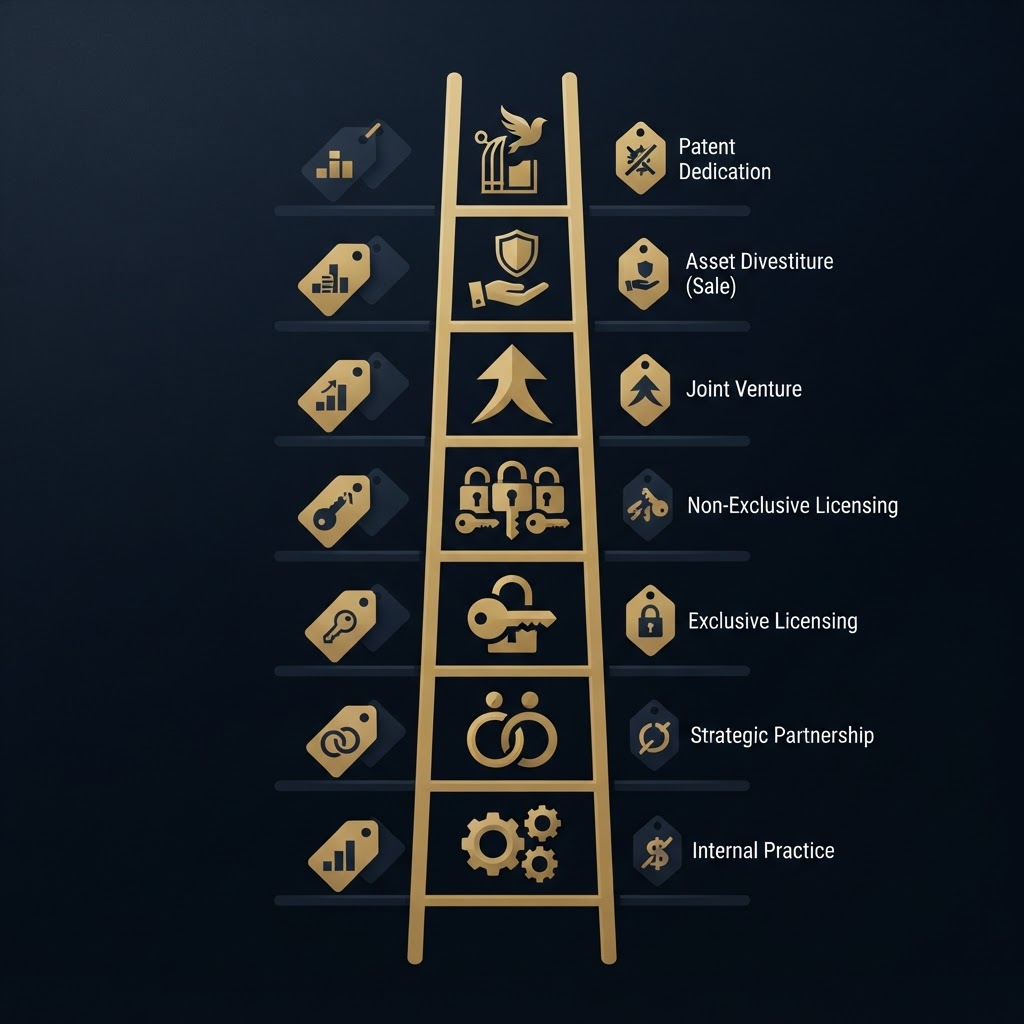
How to monetize a patent is usually answered with a list. Manufacture it, license it, sell it, sue infringers. Five bullet points, a paragraph each, and a suggestion to call a lawyer. The list is not wrong. It is just unsorted. A route that needs a seven-figure litigation budget sits next to one that needs a broker and a claim chart, as if an inventor with one patent could pick either. They cannot. This guide sorts the seven routes by what each one costs to enter and by the four facts that open or close it, then sends you to the deeper piece on each path. ## The short answer A patent earns nothing on its own. It is a negative right, the power to exclude others for the patent term, and that power only turns into money through action. Most owners never take it. More than half of all patents expire early because owners stop paying maintenance fees, and the same Quinn Emanuel paper cites the estimate that about 95 percent of patents are unlicensed. There are seven ways out of that drawer: practise it, sell it, license it, carve it by field or territory, enforce it, borrow against it, or hold it and release it deliberately. An owner without a litigation budget can realistically use three or four of them. Which ones depends on four facts you can check in an afternoon. ## Four facts that open or close every route ### Do the claims read on real products? This is the largest single factor. A marketplace guide that prices the routes side by side calls claims reading on real products the decisive requirement, and in its worked example the documented claim chart, not the patent itself, was what made a sale possible. No product that reads on the claims means no licensee, no buyer motivated by risk and nothing to enforce. ### How much term is left? Under about three years of remaining term, every outside route gets very hard. Buyers and licensees pay for future exclusivity, and there is little left to pay for. ### Can you fund enforcement? Licensing and enforcement both lean on a credible threat to sue. If you cannot fund one, those routes weaken and selling to someone who can usually wins. We work through that trade-off with the numbers in license or sell. ### Granted or pending? A pending application can be sold, licensed or optioned, but the claims have not been examined, so every counterparty discounts it. The timing question is covered in selling a pending application. ## The seven routes ### 1. Practise it yourself Build the product and use the patent as a moat. A WIPO training paper on commercialising inventions puts it plainly: own manufacturing offers the highest potential return and needs the largest investment, while licensing or selling early pays less but costs far less to pursue. Here the patent is not a revenue line. Its value shows up as margin you protect. One housekeeping rule from the Outside IP Counsel guide matters: in the US, mark your product with the patent number, because under 35 USC 287 an unmarked product can limit damages to the period after actual notice. Fits: founders who were going to build the company anyway. ### 2. Sell it A sale is an assignment, a permanent transfer for a lump sum. It is the only route that pays you and also ends the maintenance fees, the validity defence and the enforcement burden in one step. That matters more than it sounds: by Ipiry's fee table, across a US patent's life the large entity maintenance fees alone total 14,470 USD, or 5,788 USD for a small entity. The hard part is not the paperwork, it is finding a buyer. Start with how selling a patent works, then who buys patents and what patents sell for. Fits: owners who do not practise the patent, cannot fund enforcement and want certainty. ### 3. License it A licence grants permission to use the invention while you keep title. One patent attorney calls it the most common way to monetize a patent, with the key structural choice being exclusive (one licensee, higher fees) or non-exclusive (several licensees). What the list posts skip: under a licence, every ongoing cost stays with you. Fees, validity defence, monitoring, audits and enforcement against anyone who did not sign. Price a royalty against those costs, not against zero. Typical rates are in patent licensing royalty rates, and the firms that run licensing programmes for owners are compared in patent licensing companies. Fits: owners with a patent that someone already wants to use, time to negotiate, and a credible way to enforce. ### 4. Carve it by field or territory This is the route most lists fold into licensing, and it deserves its own line. Rights can be split by industry, territory or field of use, so a single patent becomes several assets. A sensor patent that reads on medical devices, cars and wearables can be kept for medical, sold for automotive and licensed non-exclusively for wearables. It is how we structure our own rights: EX IX sells and licenses patent rights carved by industry, territory or field of use, with the legal title kept whole. The mechanics are in selling patent rights by field. Fits: patents whose claims read on more than one market, where the owner only serves one of them. ### 5. Enforce it Sue infringers for damages, or send a demand letter to open a licence negotiation. This is the route that produces the headline verdicts, and it is the one most individual owners cannot afford. The best public cost data is the AIPLA economic survey. In its 2019 round, the median cost of a patent case through trial and appeal was about 700,000 USD with under 1 million at risk, 1.5 million USD with 1 to 10 million at risk, and 4 million USD with more than 25 million at risk. Those are medians from attorneys and in-house counsel, not quotes. Cost is only half of it. A pointed demand letter can give the recipient standing to file first for a declaration that your patent is invalid or not infringed, in a court of its choosing, and an accused infringer can challenge the patent at the PTAB. Enforcement puts the asset itself at risk. Even so, the Quinn Emanuel paper is blunt that no licensing campaign fully succeeds without a willingness to litigate, which is why a buyer who can enforce often pays more than the patent earns for an owner who cannot. Fits: well-funded owners with strong evidence of infringement, or the buyers they sell to. ### 6. Borrow against it The route almost no monetization guide mentions. A patent can secure a loan, either as collateral in its own right or as comfort alongside the business's cash flow. WIPO lists patents among the IP assets easiest to use for debt financing and describes a sale and licence-back structure where a financier buys the patent and you keep using it under an exclusive licence. The caveats are heavy. Lenders apply lower loan-to-value ratios to IP than to property, and the security usually comes with conditions that forbid selling, exclusively licensing or abandoning the patent while the loan runs. That can block routes 2 to 4. A WIPO expert presentation puts recovery rates for IP collateral as low as 10 to 20 percent, against 60 to 80 percent for tangible assets, which is why lenders price it cautiously. Practice also varies by country. German law allows a pledge or a security assignment of patents, while the same study notes Japan bars patent applications as collateral, and in France's loan register patents appear in only 26 percent of IP-backed loans against 84 percent for trademarks. Fits: operating companies with revenue, where the patent supports a loan the business can service. It is not a way to cash out an idle patent. ### 7. Hold it, or let it go on purpose Holding a patent defensively has value only if its claims reach what a likely opponent actually does. A hundred patents that cover nothing a competitor makes provide no leverage. Releasing a patent is a legitimate outcome, and the market does it constantly. According to the Ipiry pricing guide cited above, 58.6 percent of US utility patents are abandoned before full term. The failure is not letting a patent go. It is letting it go at a fee deadline without having checked whether anyone would buy it first. Our guide to patent annuity fees covers when the fee stops being worth paying. Fits: patents with no readable product and no buyer, after the sale route has been tested. ## The routes side by side | Route | Entry cost | Ends your fees? | Typical fit | | --- | --- | --- | --- | | Practise | A whole company | No | Founders building the product | | Sell | Broker commission | Yes | Non-practising owners wanting certainty | | License | Negotiation, monitoring, enforcement | No | Patents someone already wants | | Carve by field | Deal structuring | Partly | Patents reading on several markets | | Enforce | Hundreds of thousands to millions | No | Funded owners or their buyers | | Borrow | Valuation and lender diligence | No | Operating companies with revenue | | Hold or release | The fees, or nothing | Release does | Patents with no reader and no buyer | Read the second column and the pattern is plain. For an individual inventor or a small company, the realistic shortlist is sell, license, or carve, with release as the fallback. The rest belong to companies with a product line or a litigation budget, and strategy at that scale is a portfolio question; our parent company's guide to patent portfolio strategy covers how to build, prune and monetise a whole portfolio. ## Where most monetization efforts actually fail Not at the contract. At the counterparty. Every route except practising and releasing needs someone on the other side: a buyer, a licensee, a lender, a defendant. Finding that someone is most of the work, and it takes longer than owners expect, which is why we wrote up how hard it is to sell a patent with the real odds. The second failure is timing. Routes close as a patent ages and fee deadlines approach. Start a sale or licensing process twelve months before a maintenance fee is due and every route is open. Start six weeks before and the only choice left is pay or lapse. If outreach is the gap, read how to market a patent without turning it into one more listing nobody answers. ## How we monetize patents at EX IX We are a patent M&A firm, not a bulletin board. The first thing we do with any patent is answer the four facts above, through a validation gate that runs physics-grade claim reconstruction, detectability analysis and a validity probability before a buyer or licensee ever sees a teaser. Detectability is the answer to "do the claims read on real products", and it decides which routes are open. Then we pick the route that closes. Sometimes that is a sale, sometimes a carve, sometimes a licence. Our brokerage is success-based: commission paid by the seller on completion, minimum EUR 5,000 per completed transaction. No sale, no fee. If you are comparing intermediaries, understand what a patent broker does first, and if price is the open question, start with how to value a patent. One limit, stated plainly: EX IX is not a firm of patent attorneys. We structure the deal and find the counterparty. Assignments and licences are drafted and executed through an independent licensed attorney of record. Nothing here is legal or tax advice. ## FAQ ### Can you monetize a patent without making a product? Yes. Selling, licensing and carving rights all work without your own product, as long as someone else's product reads on the claims. Documented evidence of that, usually a claim chart, is what turns the patent into something a buyer or licensee will pay for. ### Can you get a loan against a patent? Sometimes. Lenders accept patents as collateral or as support for cash flow lending, but at lower loan-to-value ratios than property, and usually with conditions that stop you selling, exclusively licensing or abandoning the patent while the loan runs. It suits operating companies with revenue more than idle patents. ### How much does it cost to enforce a patent in the US? The AIPLA 2019 survey puts the median cost through trial and appeal at about 700,000 USD when under 1 million USD is at risk, and 1.5 million USD when 1 to 10 million is at risk. Many cases settle earlier, but the accused party can also challenge the patent's validity, which adds cost and risk. ### Can a pending patent application be monetized? Yes. A pending application can be sold, licensed or optioned, but every counterparty discounts it because the claims have not been examined yet. An option or licence that converts at grant often preserves more value than an outright sale of the uncertainty.
We use essential cookies to operate this website and, with your consent, optional cookies to understand site usage. You can accept or decline non-essential cookies at any time. See our Impressum for our contact and legal details.