 October 2026
How to Sell a Patented Product: Two Deals, One Patent
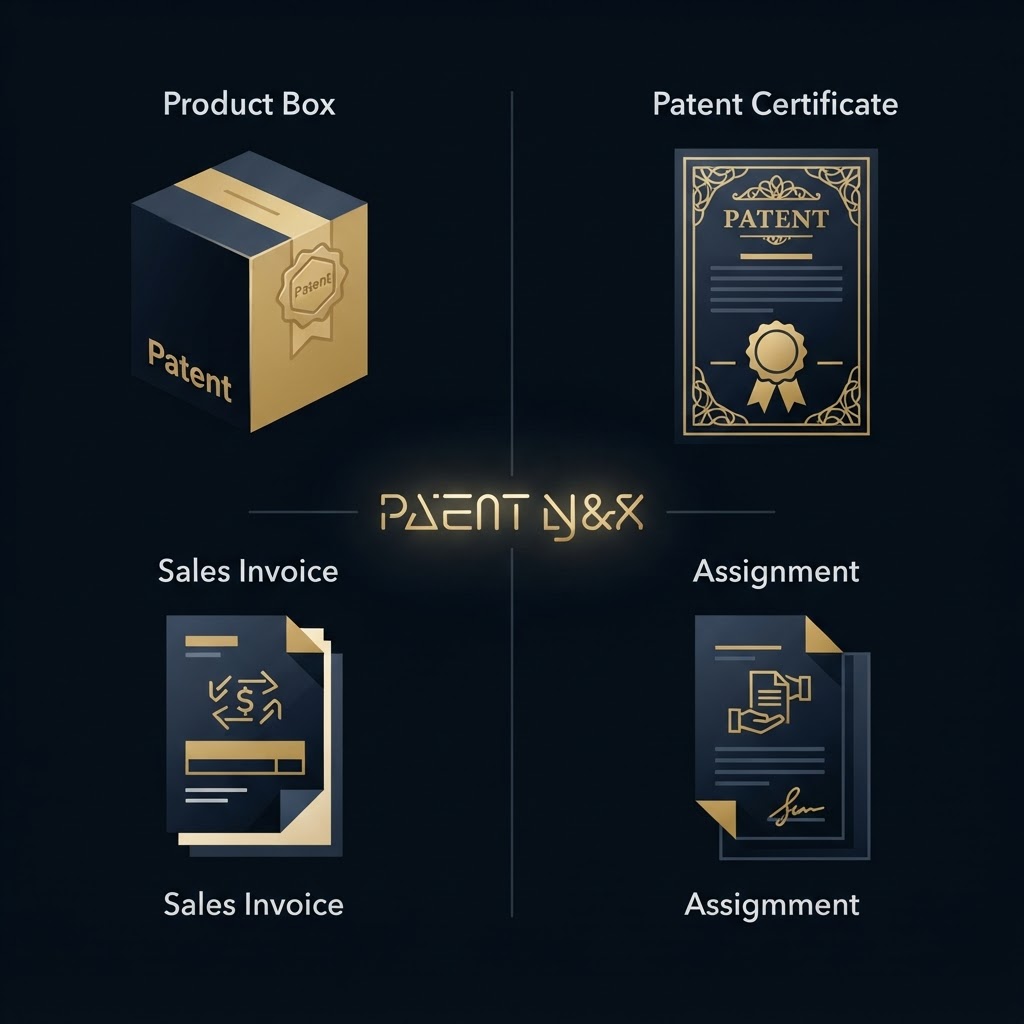
Ask a search engine how to sell a patented product and you get two kinds of answers mixed together. Half the pages tell you how to manufacture, mark and ship a product that happens to be patented. The other half tell you how to sell the patent. Those are different transactions with different buyers, different paperwork and different prices, and treating them as one is how inventors end up with the worst of both. This guide separates them, adds the post-grant rules the first page of results mostly skips, and ends with the one piece of sequencing the data supports. ## First decide which of the two things you are selling A patent is not the technology. A broker's guide puts it bluntly: a patent is a right to exclude others from practising the invention, so when you sell the patent you are not selling a right to use your technology, you are selling the right to prevent others from developing technologies that use it. The product is a separate asset. You can sell one, the other, or both, and the buyer for each is usually a different company. So the first question is not "how do I sell it" but "which of these am I selling": - The product. You or a partner make it and sell units. The patent is a moat around the margin.
- The right to make it. You keep the patent and license a manufacturer. Royalties replace margin.
- The patent itself. You assign title. Someone else owns the moat from then on. If you already know you want out, start with whether to license or sell your patent. If the patent has not issued yet, the rules differ enough that we cover selling a product while the patent is still pending separately. The rest of this article assumes a granted patent. ## Route one: sell the patented product yourself This is the route where the patent does the most for you and asks the most of you. The attorney-reviewed guide most inventors land on lists what you take on: the manufacturing process, supply chain operations, marketing and sales, finance, and every other business function, while competing against the very companies that might have licensed the invention from you. What it does not spell out are the four rules that govern an issued patent once a product is on the market. ### Mark it, or forfeit the damages Marking is optional in the sense that nobody fines you for skipping it. It is mandatory in the sense that skipping it costs you money later. The statute says that a patentee may mark the article with the word "patent" or "pat." and the number, or with "patent" and a free public web address that associates the article with the number, and that in the event of failure so to mark no damages shall be recovered except for infringement after the infringer was notified. Filing a lawsuit counts as notice. A label on your packaging counts from the day you apply it. Nothing counts in between. Marking also has to be kept up. A law firm summary of the case law adds that marking must be substantially consistent and continuous, substantially all patented articles should be marked, and licences should expressly require licensees to mark too. One unmarked production run from a contract manufacturer can reopen the gap. ### Virtual marking that actually counts Since 2011 you can print "Patent: yourcompany.com/patents" instead of a list of numbers. The USPTO's own report on the change explains why that matters for a product seller: where a product is already on the market and a new patent later issues, the patentee must update the mark to add the new number, and may also need to update it when a patent expires or is invalidated to avoid a false marking claim; with virtual marking only the web page needs to change. The page itself has to do real work. In the case that set the standard, a marking site listing 94 patents with no product names was held not to associate any product with any patent, the court calling it "a research project for the public", and the owner lost all pre-suit damages. Build a table: product name or model number in one column, patent numbers in the next. Archive the page every time it changes so you can prove what it said and when. ### What every sale exhausts Selling a patented product does something to the patent that many inventors do not expect. The Supreme Court held in 2017 that a patentee's decision to sell a product exhausts all of its patent rights in that item, regardless of any restrictions the patentee purports to impose or the location of the sale; a contract restricting resale may be enforced as contract, but not through an infringement suit. The case involved toner cartridges sold at a discount on a single-use promise and then refilled by a third party. The patentee lost on both the domestic and the imported cartridges. For a small manufacturer the practical reading is simple. The patent stops copying. It does not control what buyers do with the unit they paid for, and it does not stop grey imports of units you sold cheaper abroad. If you want either of those, write it into the sales contract and price the risk, because the patent will not carry it. ### Your patent stops at the border The same opinion restates the territorial rule: the Patent Act limits the right to exclude to making, using, selling, offering for sale or importing within the United States. A US grant gives you nothing against a copier manufacturing and selling in Germany. If Germany or the wider EU is a sales market, the question is whether a corresponding German or European patent exists, and if it does not, your product sells there on brand and speed alone. That is fine as a choice. It is expensive as a surprise. The upside of this route is the one measured figure in its favour. In a survey of inventors, nearly half of those who decided to produce and market the invention themselves claimed to be successful. The same survey has a much lower number for the next route. ## Route two: license the patent to a company that sells the product Licensing keeps the patent with you and hands the factory problem to someone who already has a factory. The core terms are few: the royalty, usually a percentage of revenue or a payment per unit; the territory; the term, often around five years; and whether the licence is exclusive or non-exclusive, with manufacturing rights and distribution rights licensable to different companies. Field of use is the lever that page omits: licensing the medical application to one company and the industrial one to another is how a single patent earns twice. Two realities deserve stating in the same breath. First, the odds. The Zimmer and Westrum study cited above found that only about 13 percent of inventors who attempted to license their invention succeeded, and that royalties often range from 2 to 10 percent of net revenues. Second, the rate. The Licensing Executives Society's high-tech survey puts the average running royalty at 5.69 percent and the median at 5 percent, with a ten-year average of 5.73 percent. An academic review of licensing practice records the old rule of thumb behind those numbers: of ten laboratory inventions one is patented, one in ten patents is licensed, and one in ten licences earns more than 25,000 dollars a year; licensors start from a 25 percent share of pre-tax profit or, for reasons nobody can explain, 5 percent of sales. Treat all of these as a starting point for negotiation, not a formula, and check royalty rates by industry before you quote one. Finding the licensee is the hard part, and it is a sales process rather than a listing. We cover the buyer list, the package and the outreach in how to market a patent. ## Route three: sell the patent, with or without the product Assignment is the clean exit. The analogy the legal guides use is a house: licensing is renting it to tenants, assigning is selling it, and because an assignment is complete and final you should expect most if not all of the price up front rather than as future royalties. If a buyer wants to pay mostly in royalties, restructure it as a licence so you keep the right to walk away. Who pays and why is covered in who buys patents, and the price ranges in how much a patent sells for. One point from the broker's guide matters specifically to product sellers: existing licensees affect the marketability and value of the patent. An exclusive licence you signed in year one can remove most of what a buyer wanted in year four. A non-exclusive one lowers the price but may add an income stream the buyer values. Decide before you sign the licence, not after. You can also sell the product business and the patent together as one company sale. That is usually the highest-value outcome and the subject of a startup built around a patent. ## The sequencing most guides miss The pages above present the three routes as a personality test. The data suggest they are a sequence. A study of 867 Swedish patents held by individuals and small firms found that 61 percent were commercialised overall but only 51 percent of those held by individual inventors, that roughly 12 percent were sold or licensed, and, most usefully, that of the 50 patents which changed commercialisation mode, 38 were first brought to market by the owner and only then sold or licensed. The authors' explanation is asymmetric information: buyers cannot see an invention's quality, so the inventor who enters the market first reveals it, and then collects a higher acquisition or licensing price through bidding competition. Read against the marking and exhaustion rules above, that gives a concrete playbook for an issued patent: 1. Sell units first, even a small run. Mark them from day one and keep the marking record. Sales are the proof a buyer or licensee cannot generate for themselves.
- Keep the licence map clean. Do not grant an exclusive worldwide licence to the first distributor who asks. Carve by field, territory or term so a later buyer still has something to buy.
- Sell or license the rights once the numbers exist. A patent plus a year of sales, marking and no exhausted claims is a different asset from a patent plus a prototype. The price reflects it. The step from grant to proven sales is also where most of the value curve lives, which is why we explain what changes at grant and the method for valuing the patent separately. ## How we broker the rights once the product has proven them We run the third step for owners who have done the first two, and the economics are stated up front: commission is paid by the seller on completion, with a minimum fee of EUR 5,000, and no sale means no fee. Rights can be carved by industry, territory or field of use, which is often what lets a product company sell the patent for one application and keep manufacturing in its own. Before any asset reaches a buyer it passes a validation gate: physics-grade claim reconstruction, detectability analysis and validity probability, benchmarked at 0.76 percent mean absolute percentage error against real-world outcomes. Detectability is the part that matters most to a seller with units in the market, because a buyer who can see how a copy would be proven prices the patent instead of discounting it. Two caveats, plainly. Our own first listed family, Edge Assist, is application P00202606645, filed and pending examination, with grant uncertain, so we say pending application, never granted patent, and we hold every seller to the same wording. And EX IX is not a firm of patent attorneys, and a novelty search does not guarantee grant or patentability. Nobody can promise a buyer or a price for a patented product. Anyone who does is selling certainty the market has not issued. ## FAQ Do I have to put the patent number on the product to sell it? No. Selling an unmarked patented product is legal. The cost is that you cannot recover damages for infringement that happened before the infringer received actual notice, usually a letter or a lawsuit. Marking "Patent" with the number, or "Patent" with a public web address that lists the product and its patent numbers, starts the damages clock without a letter. Can I stop buyers reselling or refilling my patented product? Not with the patent. An authorised sale exhausts your patent rights in that unit, including sales made abroad, so resale, repair or refill by the buyer is not infringement. You can restrict those things by contract with the buyer and enforce the contract, but the remedy is contract damages, not an infringement suit. Does selling the product in Germany need a German patent? To stop copying in Germany, yes. A US patent only covers acts within the United States. You can sell the product in Germany without a German or European patent, but a competitor can make and sell the same product there, and your US patent gives you nothing against them unless their units are imported into the US. Does an existing licence make my patent harder to sell? Often. An exclusive licence hands the licensee most of what a buyer would want, so the buyer may only be interested if the licensee is the buyer. A non-exclusive licence lowers the headline price but gives the buyer an income stream. Either way, disclose every licence in the data room, because an undisclosed one is the fastest way to lose a deal at due diligence.
We use essential cookies to operate this website and, with your consent, optional cookies to understand site usage. You can accept or decline non-essential cookies at any time. See our Impressum for our contact and legal details.